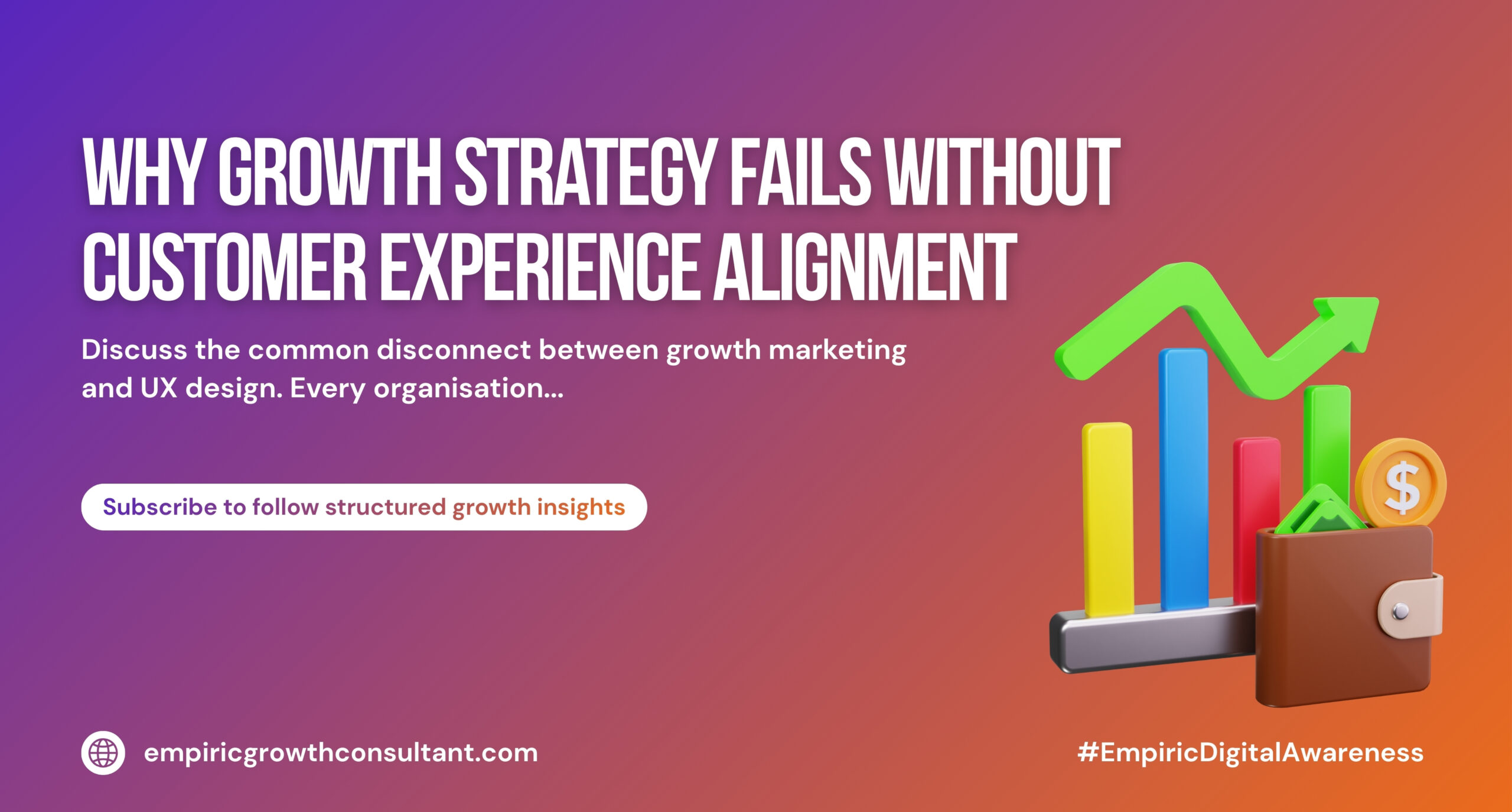
→ Discuss the common disconnect between growth marketing and UX design.
Every organisation today wants growth—faster, smarter, and more measurable. Leaders invest in marketing, analytics, and automation platforms, expecting to see exponential results. Yet, despite sophisticated tools and ambitious strategies, many growth initiatives underperform.
The reason often isn’t strategy—it’s misalignment between growth marketing and customer experience (CX). When business growth plans ignore the human side of design, brands end up driving activity, not loyalty. We’ve seen that sustainable growth comes from a single truth: customers don’t buy growth—they buy experiences.
The Root Cause: Two Worlds Operating in Silos
In many organisations, growth and experience live in different universes.
Both functions aim for success, but they speak different languages. Growth prioritises scale; design prioritises simplicity. Growth measures efficiency; design measures emotion.
When these worlds don’t align, even the most data-driven strategies struggle to connect with real people.
The Symptoms of Misalignment
You can usually spot this disconnect through a few telltale signs:
Growth that isn’t anchored in experience becomes transactional—focused on numbers, not relationships.
Why Customer Experience Must Lead Growth Strategy
Growth is no longer just a marketing challenge; it’s a design challenge. True business growth depends on how deeply an organisation understands and designs around its customers.
Here’s why CX alignment is the foundation of modern growth:
Experience Builds Trust
In saturated markets, trust is the ultimate differentiator. When customers feel understood and valued, they stay longer, spend more, and advocate naturally. Growth driven by experience creates long-term compounding effects that ads alone can’t achieve.
Design Guides Conversion
UX design isn’t just about aesthetics—it’s about reducing friction. From landing pages to product onboarding, every interaction shapes whether a user continues or drops off. A growth strategy that doesn’t integrate UX design often loses efficiency at the most critical point: user action.
Emotion Drives Retention
Data may attract customers, but emotion keeps them. Great experiences trigger emotional connections—trust, delight, and satisfaction—that no discount or campaign can replicate. Aligning growth strategy with emotional design ensures consistency across every touchpoint.
Feedback Fuels Innovation
Experience-focused growth teams continuously gather and interpret customer feedback. This feedback becomes a data stream for product improvement, segmentation, and innovation—turning qualitative insight into quantitative growth.
Building Alignment: A Unified Growth–Experience Framework
The solution is integration. Growth strategy and customer experience must be designed as one ecosystem. A practical alignment framework includes:
When growth strategy and UX collaborate from day one, businesses build experiences that sell themselves.
The Cost of Ignoring Experience
A disjointed customer experience can silently erode growth. Every confusing interface, delayed response, or inconsistent brand touchpoint pushes customers away.
Without CX alignment, marketing budgets inflate while ROI declines. Teams work harder but achieve less. Growth plateaus not because of poor strategy—but because the strategy feels disconnected from the people it’s meant to serve.
The Empiric Perspective
We believe that growth and experience are two sides of the same coin. A truly effective growth strategy begins with empathy, is validated by data, and is delivered through design. We help organisations bridge the gap between business intent and customer reality—ensuring that every campaign, touchpoint, and experience works together to create measurable, sustainable growth.
Because when strategy meets experience, growth isn’t forced—it flows.
November 11, 2025
Leveraging Machine Learning for Predictive Marketing
October 10, 2025
The Psychology of Web Design: Turning Visitors into Clients
Turn your business goals into a clear, focused growth strategy. Work with Empiric Growth Consulting to identify opportunities, overcome growth challenges, and build a scalable path toward sustainable results.