About the Client
A rapidly expanding professional services firm relied on spreadsheets, disconnected software, and manual workflows to manage projects, clients, and internal operations. As the business grew, these processes became inefficient and increasingly difficult to scale.
The Challenge
The organization struggled with fragmented data, repetitive administrative work, delayed reporting, and limited visibility into business performance. Employees spent valuable time on manual tasks rather than serving clients.
Disconnected business systems
Manual data entry
Limited reporting capabilities
Poor workflow visibility
Difficulty scaling operations
We designed and developed a centralized business management platform tailored to the client's operational requirements. The solution focused on automation, collaboration, and real-time reporting while remaining flexible for future growth.
The project included:
Evaluated existing workflows to identify opportunities for efficiency and automation.
Designed a scalable and secure architecture tailored to business requirements.
Built a feature-rich web application to streamline business operations.
A website is more than a digital brochure—it should actively support business growth.
A website is more than a digital brochure—it should actively support business growth.
A website is more than a digital brochure—it should actively support business growth.
We collaborated with stakeholders to map existing workflows, identify operational bottlenecks, and define future business requirements.
A secure web-based platform was built with role-based access, centralized data management, project tracking, and document storage.
Routine tasks such as approvals, notifications, reporting, and status updates were automated to eliminate repetitive manual work.
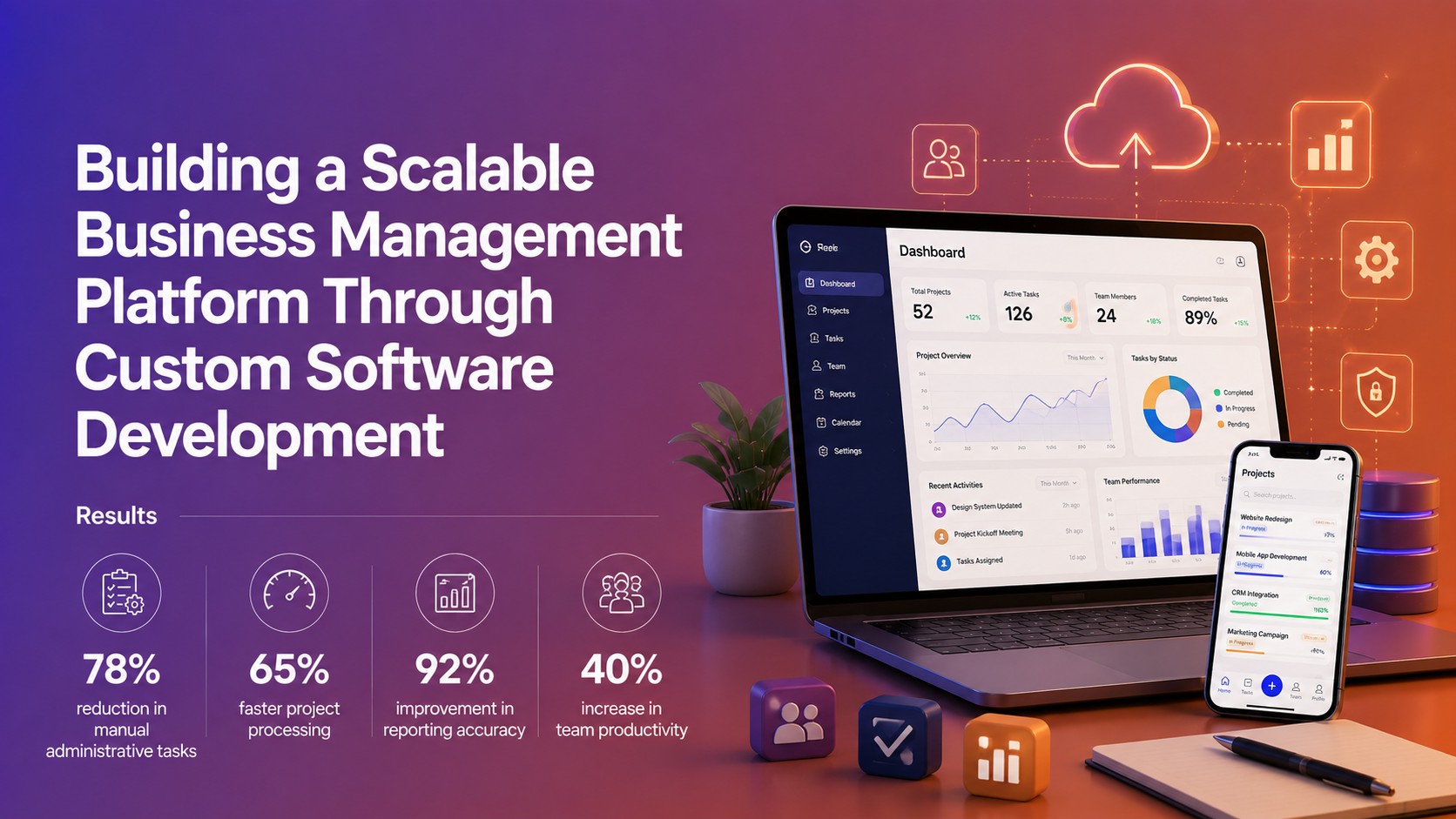
Interactive dashboards provided management with real-time visibility into projects, team performance, and operational KPIs.
The platform was implemented in phases with user training and post-launch support to ensure smooth adoption across the organization.




Following implementation, the client experienced:
Custom software should simplify operations rather than add complexity. By replacing fragmented systems with an integrated platform, the client streamlined workflows, improved collaboration, and established a scalable foundation for future business growth.