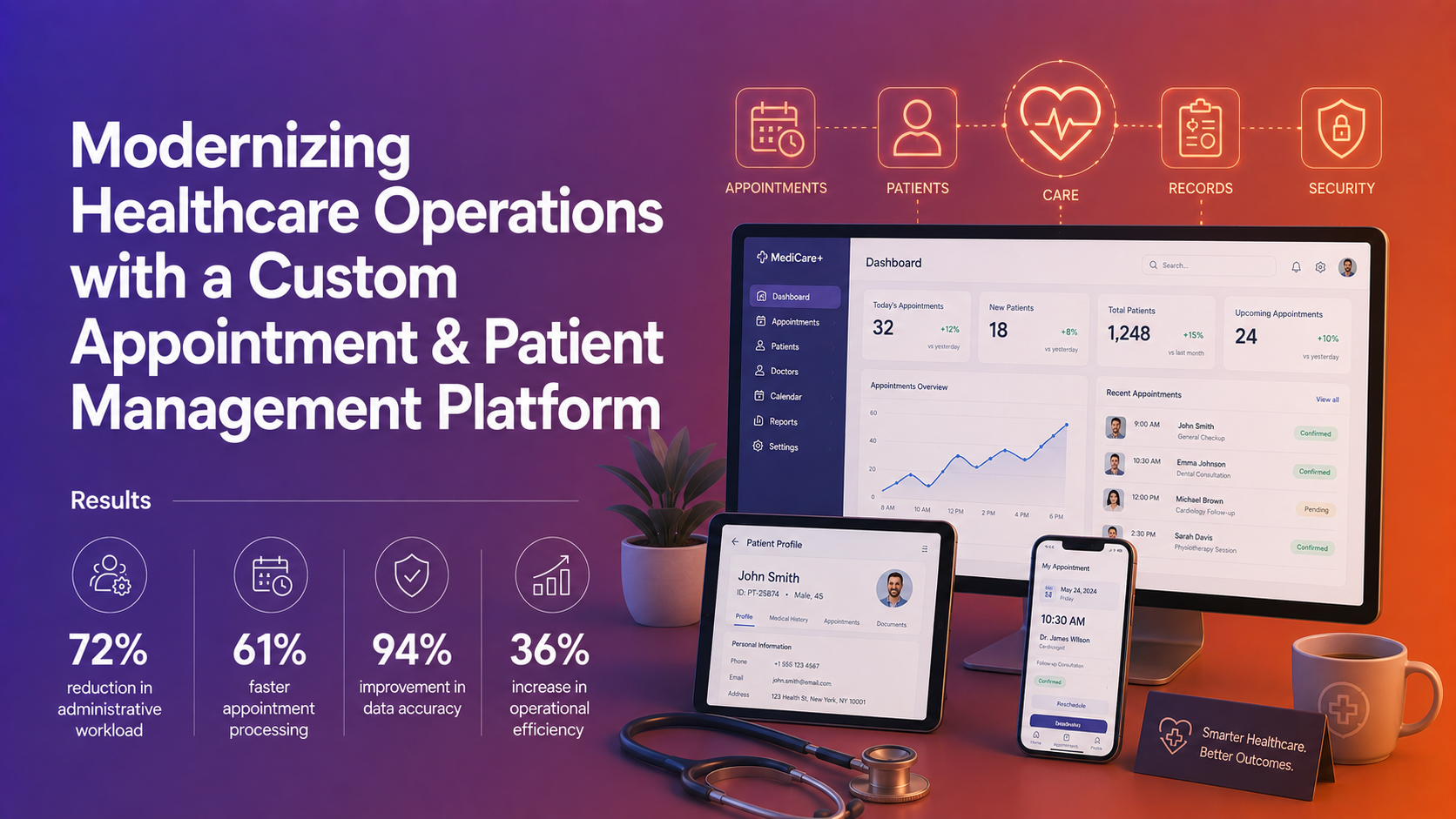
About the Client
A growing healthcare organization managing multiple departments relied on manual scheduling, paper-based records, and disconnected software systems. As patient volumes increased, these outdated processes affected operational efficiency and patient experience.
The Challenge
Managing appointments, patient information, and internal workflows across departments became increasingly complex. Staff spent considerable time on repetitive administrative tasks, leading to scheduling conflicts, delayed reporting, and reduced productivity.
Manual appointment scheduling
Fragmented patient records
Time-consuming administrative processes
Limited operational visibility
Inefficient communication between departments
We designed and developed a centralized healthcare management platform tailored to streamline appointments, improve collaboration, and automate routine administrative tasks while maintaining high standards of security and compliance.
The engagement included:
Assessed existing workflows to identify operational improvements and automation opportunities.
Designed a secure, scalable architecture to support long-term business growth.
Developed tailored software solutions aligned with unique business requirements.
A website is more than a digital brochure—it should actively support business growth.
A website is more than a digital brochure—it should actively support business growth.
A website is more than a digital brochure—it should actively support business growth.
We worked closely with clinical and administrative teams to understand existing workflows, identify inefficiencies, and define system requirements.
A secure, cloud-based application was developed to manage appointments, patient profiles, user roles, notifications, and reporting through a centralized dashboard.
Appointment confirmations, reminders, staff notifications, and administrative approvals were automated to reduce manual intervention and improve efficiency.
Interactive dashboards enabled management to monitor appointments, resource utilization, operational performance, and patient trends in real time.
The platform was rolled out in phases with comprehensive staff training, ensuring smooth adoption and minimal disruption to daily operations.




Following implementation, the healthcare organization achieved:
Technology should simplify healthcare operations, not complicate them. By replacing fragmented workflows with a centralized, automated platform, the organization improved efficiency, enhanced patient experience, and created a scalable foundation for future growth.