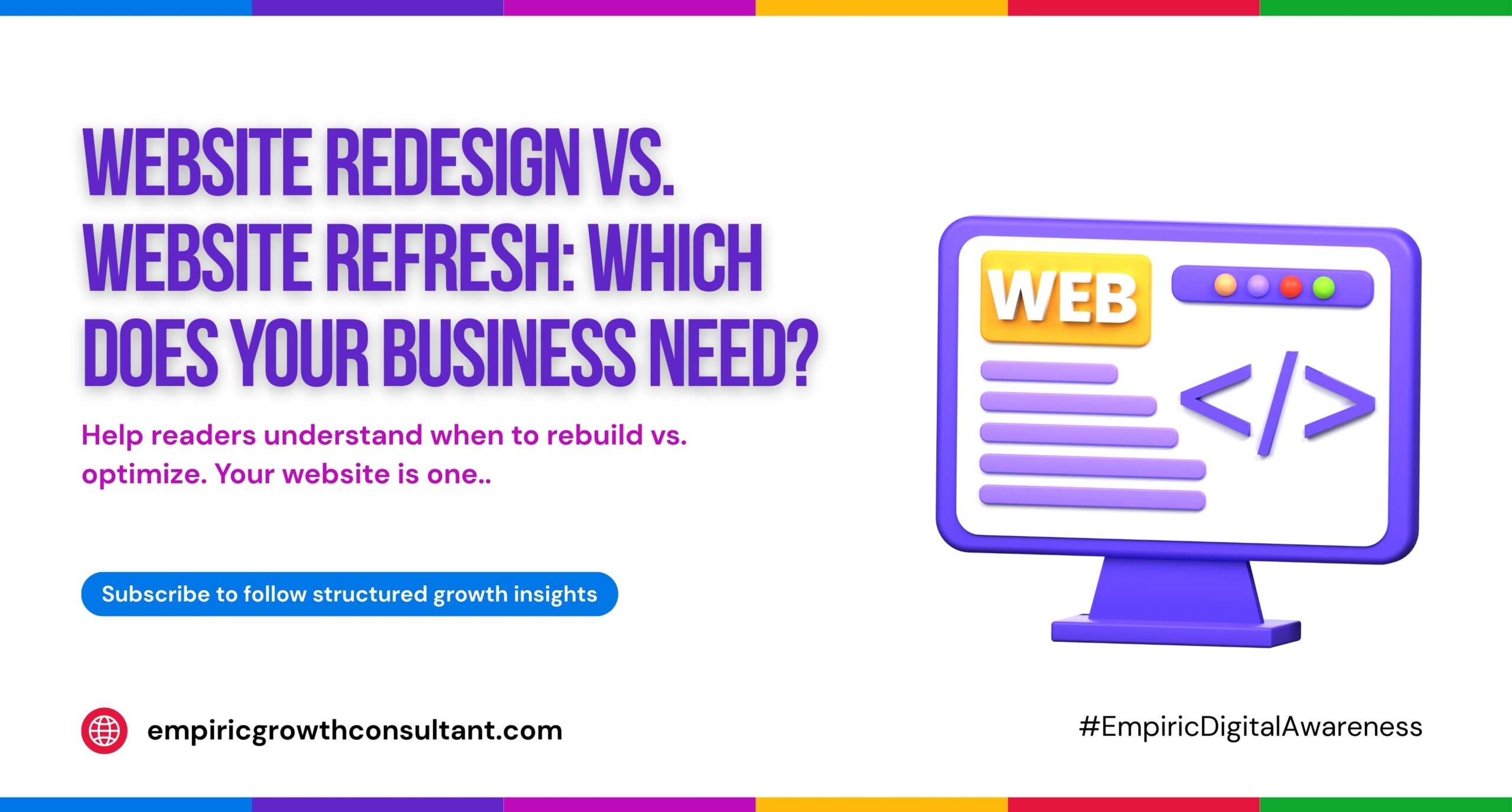
→ Help readers understand when to rebuild vs. optimize.
Your website is one of your most powerful growth assets — but even the best designs lose effectiveness over time. Markets evolve, user expectations change, and technology advances. At some point, every organisation faces a crucial question:
Should we refresh our website — or redesign it completely?
We’ve helped clients navigate this decision through a structured, data-driven lens. The goal isn’t to chase trends — it’s to determine what will actually drive measurable growth.
Understanding the Difference
Before you can decide which path to take, it’s important to clarify what each approach truly means.
A Website Refresh
A refresh is a strategic optimisation of your existing site — refining visuals, messaging, and structure without rebuilding the core framework. Think of it as a “tune-up,” not a full reconstruction.
A refresh keeps the foundation intact but elevates the experience to align with new goals or customer expectations.
A Website Redesign
A redesign, on the other hand, is a complete rebuild — rethinking the architecture, functionality, design language, and even technology stack. It’s ideal when your current site can’t support your growth vision.
In essence, a redesign isn’t about “fixing” — it’s about redefining.
The Strategic Question: When Does Each Make Sense?
The decision depends on your business goals, user feedback, and data performance. Here’s how to evaluate:
You Need a Refresh If:
Example: A consulting firm noticed bounce rates creeping up but brand perception remained strong. A refresh — focusing on clearer messaging and faster load times — reversed the trend in 60 days.
You Need a Redesign If:
Example: A SaaS company pivoting from B2C to B2B rebuilt its website around new audience personas, messaging, and architecture. The redesign led to a 3x increase in demo requests.
Key Decision Factors
When assessing whether to refresh or redesign, focus on three core dimensions:
Analyse engagement data — bounce rate, conversion rate, dwell time, and device performance.
If your issues are functional and incremental, a refresh can help.
If the data shows deep UX or structural problems, it’s time to redesign.
Ask: Does our website reflect who we are today?
If your business model, audience, or visual identity has evolved significantly, a refresh won’t bridge that gap — you need a redesign.
If your current CMS or tech setup limits growth — for example, making it hard to add new sections, integrate analytics, or localise content — a redesign ensures future flexibility.
The Hybrid Approach: Redesign in Phases
Not every business has to choose between “all or nothing.” Many high-growth organisations adopt a phased redesign strategy — rebuilding critical sections first, then refreshing the rest.
This approach balances short-term ROI with long-term transformation. It also allows data from the early stages to inform later design decisions — ensuring smarter, evidence-based evolution.
Why the Decision Matters
Your website is not just a marketing tool — it’s an ecosystem of growth. A misaligned decision (refreshing when you need to redesign, or vice versa) can lead to wasted effort, poor performance, and missed opportunities. Choosing strategically ensures every design change connects to business outcomes — not aesthetics alone.
The Empiric Perspective
We believe every design decision should be rooted in data, not opinion. We help organisations evaluate their digital ecosystem through three lenses — Performance, Perception, and Potential — to decide whether a refresh or redesign best supports their growth goals. Because in the end, the right choice isn’t about how your website looks.
It’s about how effectively it drives your business forward.

November 11, 2025
Leveraging Machine Learning for Predictive Marketing
October 10, 2025
The Psychology of Web Design: Turning Visitors into Clients
September 9, 2025
From Consultancy to Partnership: Why Growth Needs an Integrated Approach
August 8, 2025
How to Identify Hidden Growth Opportunities in Your Business
We are more than just a service provider – we are your partners in success. Whether you need to amplify your marketing efforts, revamp your website, or develop a powerful application, we are here to help you navigate the digital landscape and achieve your business goals. Let's embark on this journey together and unlock your true potential.